What Are Loafers? A Brand Buyer’s Guide to This Enduring Icon
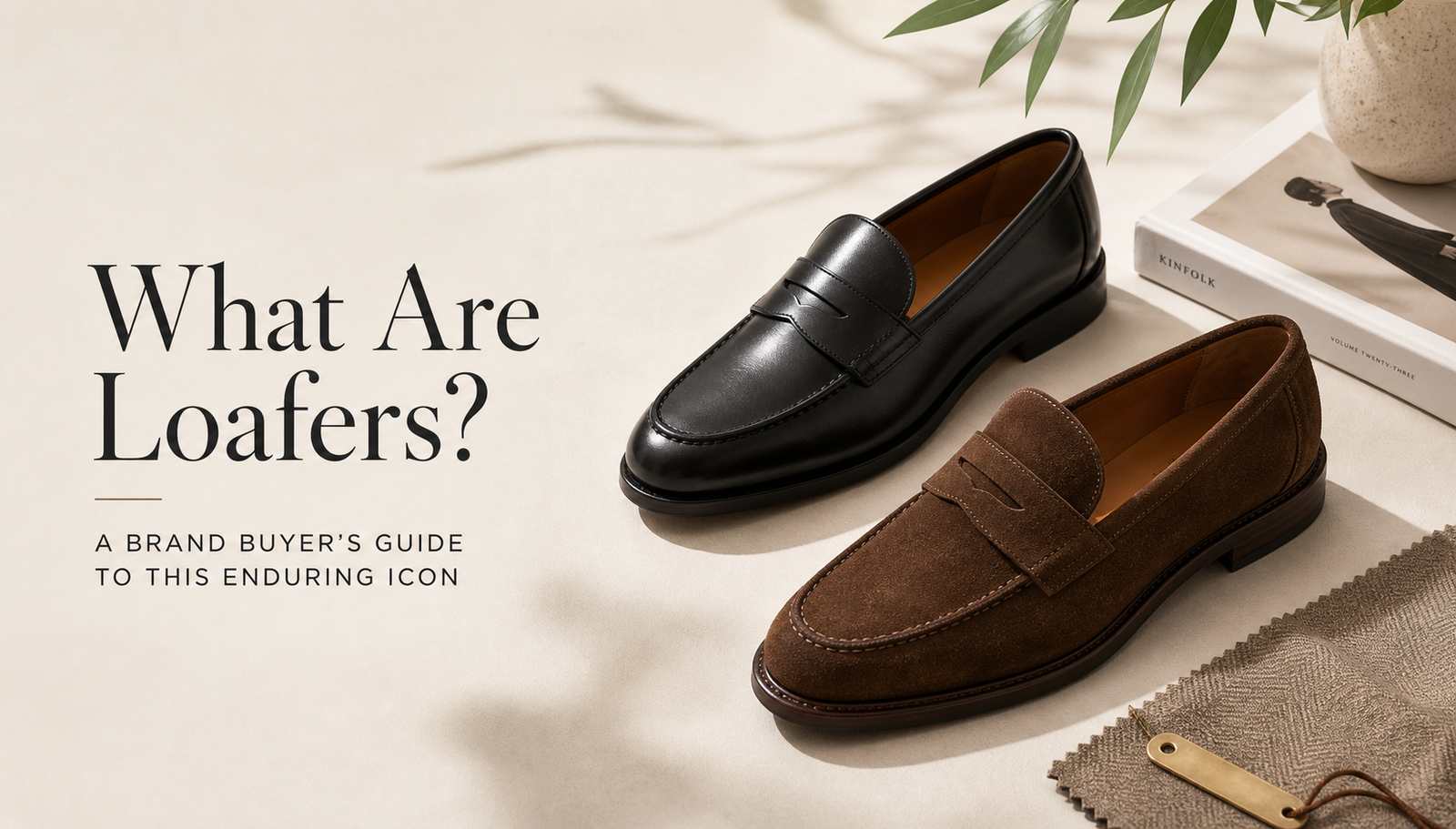
Loafers are slip-on, laceless shoes with a low-cut ankle, a moccasin-inspired stitched upper, and a decorative element across the vamp — a silhouette that has survived 100 years of fashion cycles and remains a non-negotiable line item on every serious footwear brand’s seasonal buy sheet.
If you’re sourcing footwear for a brand, you already know this: loafers sell. They sell in Milan and in Tokyo, in corporate lobbies and on resort terraces, to 25-year-old startup founders and 55-year-old managing partners. No other shoe type — not the oxford, not the derby, not the sneaker — spans formal, smart-casual, and weekend as effortlessly as the loafer does.
This guide is written for brand owners, product managers, and footwear buyers. It explains what loafers are from a sourcing perspective: how they’re constructed, which variants dominate which markets, what separates a quality pair from a return-rate headache, and how to bring a loafer collection from concept to container.
The Shoe That Outlived Every Trend
A Century of Staying Power
The loafer was born around 1926, give or take a decade depending on which origin story you follow — an English royal commission for a country house shoe (Wildsmith), a Norwegian shoemaker’s fusion of Native American moccasins and fishermen’s slip-ons (Aurland), or an American prep school’s penny-in-the-strap ritual (Bass Weejuns). Three continents, three completely different use cases, one converging design.
That convergence is not an accident. The loafer solves a universal problem: the desire to look put-together without the friction — literal and metaphorical — of laces. A century later, that problem hasn’t gone anywhere.
Numbers Don’t Lie
The global loafer market has shown consistent growth across the last decade. In Europe, loafers account for a meaningful share of men’s non-sneaker footwear sales, with the category expanding into women’s lines at an accelerating pace. In Japan, the loafer is practically a cultural institution — walk through Ginza or Aoyama and you’ll count more penny loafers per square meter than anywhere else on earth. In North America, hybrid designs (formal uppers on sneaker-like soles) have opened an entirely new subcategory that didn’t exist ten years ago.
For a brand buyer, the takeaway is simple: loafer demand is not seasonal, not regional, and not going anywhere.
One Silhouette, a Thousand Stories
The same basic shoe — no laces, low ankle, stitched upper — tells entirely different stories depending on the market. In Italy, it speaks of sprezzatura and artisanal leatherwork. In Tokyo, it signals Ivy League heritage and meticulous taste. In New York, it reads as efficient elegance — boardroom at 9, bar at 6, no shoe change required.
Your brand gets to decide which story to tell. But first, you need to understand the shoe itself.
Decoding the Loafer — What Actually Defines This Shoe
The Anatomy of a Loafer
Before you spec a loafer for production, you need to know its parts. Every loafer — regardless of style, price point, or factory origin — shares this anatomy:
| Component | What It Is | Why It Matters for Sourcing |
|---|---|---|
| **Vamp** | The front section covering the toes and mid-foot | Determines the decorative element (saddle, tassel, bit) — this is your product’s visual identity |
| **Apron** | The stitched panel across the top of the vamp | The moccasin-style stitching here is the loafer’s signature; inconsistent stitching = instant quality fail |
| **Heel Counter** | Internal stiffener at the back of the shoe | Determines whether the shoe holds its shape or collapses after 20 wears |
| **Collar / Topline** | The opening where the foot enters | Too loose = heel slip, your #1 return driver. Too tight = blister complaints |
| **Sole** | Leather, rubber, EVA, or TPR | Dictates the shoe’s formality level, comfort profile, and wholesale cost |
The 4 Non-Negotiables
A shoe is not a loafer unless it meets all four of these criteria:
- **No laces, no buckles, no fastenings of any kind.** It’s a pure slip-on. If you need to tie it, it’s not a loafer — it’s a derby or an oxford playing dress-up.
- **Exposed ankle.** Loafers are low-cut by definition. A shoe that wraps above the ankle is a boot, a chukka, or a high-top sneaker — not a loafer.
- **Moccasin-derived upper construction.** The separate, stitched apron across the vamp is the loafer’s genetic code. It traces directly back to Native American moccasin construction, filtered through Norwegian and English shoemaking traditions.
- **Decorative vamp element.** Something sits on top of the vamp — a leather strap (penny), a tassel, a metal bit, a bow, a kiltie fringe. This is the visual signature that defines the subcategory.
Loafer vs. Everything Else
When a brand buyer confuses a loafer with a similar shoe, the cost is a mis-spec’d production run. Here’s the quick-reference table:
| Shoe Type | Laces? | Ankle Coverage | Vamp Detail | Formality |
|---|---|---|---|---|
| **Loafer** | No | Exposed | Saddle / tassel / bit / bow | Smart-casual to formal |
| **Oxford** | Yes, closed lacing | Exposed | Plain or brogued | Formal |
| **Derby** | Yes, open lacing | Exposed | Plain or brogued | Casual to smart |
| **Monk Strap** | No (buckle) | Exposed | Buckle strap(s) | Smart-casual |
| **Moccasin** | No | Exposed | Minimal stitching | Very casual |
| **Boat Shoe** | Yes (functional lace) | Exposed | 360° lacing system | Casual |
From Norwegian Fjords to Global Factory Floors — A Design Evolution
1847–1936 · Birth of an Idea
Three events, happening almost simultaneously across Europe and America, created the modern loafer:
- **1847, London:** Wildsmith Shoes is founded, serving the Household Cavalry. In 1926, King George VI commissions a country house shoe — low-heeled, laceless, easy to slip on between hunting and dinner. The result: the Wildsmith Loafer, the first documented instance of a slip-on dress shoe.
- **1930, Aurland, Norway:** Shoemaker Nils Gregoriusson Tveranger — who spent seven years in North America studying Native American moccasin techniques — fuses Iroquois construction with Norwegian fishing-shoe design. The Aurland Moccasin becomes a sensation among American tourists visiting Europe.
- **1936, Maine, USA:** G.H. Bass reverse-engineers the Aurland design and launches the “Weejun” (a phonetic play on “Norwegian”). The diamond-shaped cutout on the saddle strap goes viral in prep schools — students slide a penny in for emergency phone calls, and the “Penny Loafer” enters the American lexicon.
Three independent inventors. One converging design. When that happens in product design history, you know you’re looking at a silhouette that solves a genuine, universal human need.
1950s–1980s · The Golden Age of Variation
Once the basic template was established, the loafer diversified — and each new variant carved out its own market segment:
- **1950, Alden × Brooks Brothers:** The Tassel Loafer is born when actor Paul Lukas brings tasseled oxfords from Europe to New York shoemakers. Alden refines the design into the “Alden Tassel,” and Brooks Brothers adds a distinctive back-seam detail. Result: a shoe that signals old-money sophistication — still the best-selling loafer in the US premium market.
- **1953, Gucci:** The Horsebit Loafer takes the penny silhouette and replaces the leather saddle with a polished metal snaffle bit. It becomes the first loafer to cross from casual into formal territory, worn by 1970s Wall Street bankers and 1980s Hollywood icons alike. The Metropolitan Museum of Art inducts it into its permanent collection in 1985.
- **1960s, Belgium:** The Belgian Loafer — soft, unstructured, with a tiny bow at the toe — emerges as a quiet-luxury alternative. Henri Bendel imports them to New York, and they become the footwear equivalent of a cashmere sweater: understated, expensive-looking, and impossible to date.
1990s–Today · The Manufacturing Shift
Here’s the part that matters for a brand buyer: until the 1990s, nearly all quality loafers came from England, Italy, or the United States. Today, the global supply chain has shifted — and the quality has followed.
Modern factories in China, Vietnam, and Portugal now produce loafers using the same construction methods (cemented, Blake-stitched, and Goodyear-welted) that were once exclusive to Northampton and Milan. The difference is scale, speed, and cost — not craftsmanship. A well-run factory in Anhui with 11 years of loafer-specific experience can produce a penny loafer indistinguishable from a European-made equivalent, at a wholesale price that leaves margin for your brand.
The shift from regional workshop to global factory floor didn’t lower the ceiling. It raised the floor.
The Loafer Spectrum — 7 Styles Every Buyer Should Know
Each of these seven variants occupies a distinct market position. Your brand’s product mix should be a deliberate choice, not a random assortment.
1. Penny Loafer
The baseline. A leather strap across the vamp with a diamond-shaped cutout. No tassels, no metalwork, no bows — just clean, balanced proportions. Market position: volume-driven, low-risk, the Toyota Corolla of the loafer world. Sells reliably in North America, Japan, and Northern Europe. If your brand launches with one loafer, make it this one.
2. Tassel Loafer
Two leather tassels hang from the vamp. The silhouette is identical to the penny, but the personality is entirely different — more expressive, slightly rakish, steeped in Ivy League nostalgia. Market position: premium segment, strong in the US and UK. Appeals to customers 35+ who know what Alden is and care about that heritage.
3. Horsebit Loafer
A metal bar — brass, silver, or gunmetal — spans the vamp. The Gucci DNA is so strong that generic versions are still called “bit loafers” even without the branding. Market position: luxury-adjacent, highly profitable when executed well. The metal hardware is a cost and quality variable — cheap bits tarnish, good ones develop patina.
4. Belgian Loafer
Minimalist, unstructured, with a small bow at the toe. Usually unlined and worn sockless. Market position: niche luxury. Small but loyal customer base. High perceived value relative to material cost — the margins can be excellent if your brand has credibility in the quiet-luxury space.
5. Driving Loafer
Rubber pebble sole, flexible construction, designed for grip and pedal feel. The sole wraps slightly up the heel — a functional detail that doubles as a visual signature. Market position: seasonal (spring/summer), accessory-adjacent. Often bought as a second or third pair. Bright colors and suede perform well here.
6. Kilted Loafer
A fringed leather “kilt” sits beneath the vamp decoration — sometimes paired with tassels, sometimes standing alone. A heritage detail that went dormant for decades and is now surfacing in fashion-forward markets. Market position: early trend. Low volume, high margin potential. A candidate for limited drops and editorial visibility rather than steady replenishment.
7. Slipper Loafer
Velvet, embroidered, or patent leather upper with a minimal silhouette. Essentially a formal evening slipper built on loafer construction. Market position: occasion-wear. Wedding season, gala events, red-carpet-adjacent retail. Not a volume play, but a brand-elevation tool.
What Makes a Loafer Worth Buying — A Spec Sheet Perspective
This section is for the spreadsheet. When you’re comparing factory quotes, here’s what the line items actually mean.
Upper Material
| Material | Wholesale Cost Position | Perceived Quality | Durability | Best Market Fit |
|---|---|---|---|---|
| Full-Grain Calf | Higher | High | 5–10 years | Europe, Japan premium |
| Corrected-Grain | Mid | Medium | 3–5 years | US mid-market |
| Suede (Calf Split) | Mid | Medium-High | 3–7 years (with care) | Spring/summer, all markets |
| Patent Leather | Mid-High | High | 2–4 years | Formal, occasion-wear |
| PU / Synthetic | Low | Low-Medium | 1–2 years | Fast fashion, entry price point |
Sourcing tip: full-grain leather from a reputable tannery is the single biggest differentiator between a loafer that looks better with age and one that cracks within a season. If your brand promises quality, this is not the line item to cut.
Construction Method
| Method | Durability | Resoleable? | Cost | Best For |
|---|---|---|---|---|
| Goodyear Welt | Highest | Yes | Highest | Premium lines, heritage positioning |
| Blake Stitch | High | Yes (limited) | Mid-High | Italian-style slim profiles |
| Cemented | Mid | No | Low-Mid | Volume production, fashion cycles |
| Vulcanized | Mid-High | No | Mid | Driving loafers, casual sub-types |
Sourcing tip: cemented construction is not inherently bad. A well-made cemented loafer with quality adhesives and proper sole preparation can last years of regular wear. The problem is bad cementing — and that’s a factory quality-control issue, not a method issue.
Sole Engineering
- **Leather sole:** Formal. Elegant. Slippery on wet surfaces. Expected on dress loafers in European and Japanese markets.
- **Rubber (Dainite-style):** Practical. Good traction. All-weather. Preferred in the UK and increasingly in the US.
- **EVA / Lightweight:** Comfort-driven. Casual positioning. Growing demand in the hybrid “dress sneaker” segment.
- **TPR:** Elastic, shock-absorbing, good cold resistance. Budget-friendly alternative to rubber.
Lining & Insole
- **Full leather lining (calf/pigskin):** Premium feel, molds to foot, breathes. Goat leather is softer; pigskin is more durable and cost-effective.
- **Partial lining:** Heel cup lined, vamp unlined — a compromise that saves cost without sacrificing the most visible touchpoint.
- **Unlined:** Maximum breathability, minimum structure. Works well for summer suede styles and driving loafers. Not suitable for structured dress versions.
The Fit Factor
Loafers have a higher return rate than lace-up shoes. The reason is mechanical: without laces, the foot has no way to adjust the shoe’s volume. Every millimeter of fit deviation is felt immediately.
What to specify in your tech pack:
- **Heel curve:** A properly shaped heel counter that grips the calcaneus without digging. This is the difference between a loafer that stays on and one that clogs with every step.
- **Opening circumference:** Too tight = can’t get the foot in. Too loose = heel slip. The sweet spot is a collar that requires a shoe horn but doesn’t fight you.
- **Toe box tolerance:** Loafers tend to have a lower toe profile than derbies. Make sure your last allows enough vertical room for the target foot shape in your market (Japanese feet tend to be wider relative to length; Northern European feet, narrower).
Regional Preferences — What Sells Where
European Market
- **Italy:** Horsebit and tassel loafers dominate. Blake stitching is preferred for the slim, elegant profile. Colors trend toward oxblood, dark brown, and black. Suede is seasonal; calf is year-round.
- **France:** Belgian and slipper styles have disproportionate market share. Quiet luxury positioning. Unlined constructions perform well.
- **UK / Northern Europe:** Penny loafers in country-grain leather and Dainite rubber soles. Brown, tan, and burgundy. The “English country house” aesthetic still sells.
Japanese Market
American Ivy League style never left Japan. The penny loafer — particularly in shell cordovan or high-grade calf — is the dominant variant. Japanese buyers are exceptionally detail-oriented: stitch density, edge finishing, and leather quality are scrutinized far more than in Western markets. Dark brown and #8 cordovan are the colors to stock. The market rewards consistency — a loafer model that sells well this season will sell well next season. No need for constant redesign.
North American Market
Penny loafers lead, but the hybrid “dress sneaker” loafer — a formal upper on an EVA or lightweight rubber sole — is the growth story. Cole Haan proved the concept; now every brand wants a version. Color range skews wide: black for office, tan for casual, and bold colors (navy, green, even white) for the fashion-forward segment.
Emerging Markets
Southeast Asia, the Middle East, and India are building “new formal” cultures — workplaces that require smart dress but reject the stiffness of traditional suiting. Loafers fit perfectly into this space. Entry-level price points in PU or corrected-grain leather perform well as gateway products. The upgrade path (first pair in PU, second in leather) is a proven brand-loyalty flywheel.
From Sketch to Shipment — Bringing Your Loafer Collection to Life
The Design Brief
A factory needs three things to give you an accurate quote and a fast sample:
- **Reference images:** Front, side, sole, and heel views. A photo of a competitor’s product with markup notes works better than a sketch.
- **Material preferences:** Leather type, lining type, sole type. Be specific — “full-grain calf, pigskin lining, leather sole” tells a factory far more than “good quality.”
- **Target FOB and MSRP:** This frames the entire conversation. A factory that knows your target retail price can suggest material substitutions that save cost without visible quality loss.
Sampling & Iteration
A realistic sampling timeline for a new loafer design:
- **Round 1 (prototype sample):** 7–15 days. Expect fit issues, material substitutions, or construction adjustments.
- **Round 2 (revised sample):** 7–10 days. Should be close to final. Refine small details — stitch color, edge finish, branding placement.
- **Round 3 (confirmation sample):** 7 days. This is the production standard. Approve it, and every pair coming off the line should match it.
Two to three rounds is normal. A factory that promises perfection in one round is either overpromising or not paying attention.
Material Sourcing
Your factory’s relationship with leather suppliers determines your product ceiling. Ask:
- Which tanneries do they source from?
- Can they procure from a specific tannery if you provide the contact?
- Do they maintain material stock for repeat orders, or does each order require new procurement?
A factory with established supplier relationships can turn orders faster and maintain consistency across production runs.
Quality Benchmarks
When you inspect a loafer sample (or a production batch), focus on these five points:
- **Apron stitching:** Consistent stitch length, no skipped stitches, clean alignment.
- **Heel counter stiffness:** Press the heel from the inside. It should resist and spring back. A soft heel counter is a structural failure.
- **Collar elasticity:** The shoe should grip the foot without cutting into the Achilles tendon.
- **Sole adhesion:** No visible gaps between sole and upper. A thumbnail pressed into the seam should not open it.
- **Symmetry:** Left and right shoes must be mirror images. Misaligned vamps, uneven heel heights, or off-center decorative elements are reject criteria.
Certifications That Matter
If you’re selling into Europe or working with Japanese brands, BSCI and ISO certifications are not optional — they’re the minimum requirement to get past a sourcing manager’s first filter. A factory that has these certifications already in hand has been through the audit process and passed. A factory that doesn’t have them will need months to get them, and your order timeline doesn’t have that slack.
Your Loafer Manufacturing Partner
11 Years. One Focus.
XuFan Footwear (Jing County XuFan Footwear Co., Ltd.) has been manufacturing shoes from our Anhui, China facility since 2014. We operate an 8,023-square-meter factory with 2–3 production lines and an annual capacity of 1,200,000 pairs. Loafers — from classic penny silhouettes to contemporary unlined designs — are one of our core categories, alongside sandals, moccasins, German Trainers, and Birkenstock-style footwear.
OEM/ODM That Adapts to Your Brand
We don’t sell our own brand. We build yours. Send us your tech pack, your reference sample, or even just a mood board — we’ll translate it into a wearable prototype within two weeks. Our customization capabilities include:
- Debossed, foil-stamped, or metal-plaque branding
- Woven brand labels to your design
- Custom packaging: boxes, dust bags, hang tags, tissue paper
- Material sourcing to your specification — specify the tannery, and we’ll procure from it
- MOQ starting at 500–1,000 pairs per style, with negotiable trial orders for first-time partners
Built for Export
We ship FOB, CIF, and DDP worldwide, with established logistics channels to Europe and Japan. Every order is backed by BSCI and ISO certifications, and we provide compliance documentation on request — REACH, CPSIA, or your market’s specific requirements.
Start Your Next Collection
Whether you’re launching a new loafer line, expanding an existing range, or exploring a private-label opportunity — we’ll reply to your inquiry within 24 hours with pricing, a sampling plan, and clear answers.
📧 info@xufanshoes.com
Jing County XuFan Footwear Co., Ltd. | OEM/ODM Footwear Manufacturer Since 2014 | Anhui, China | BSCI · ISO Certified