
What Are Moccasins? A Brand Buyer’s Guide to Footwear’s Oldest Silhouette
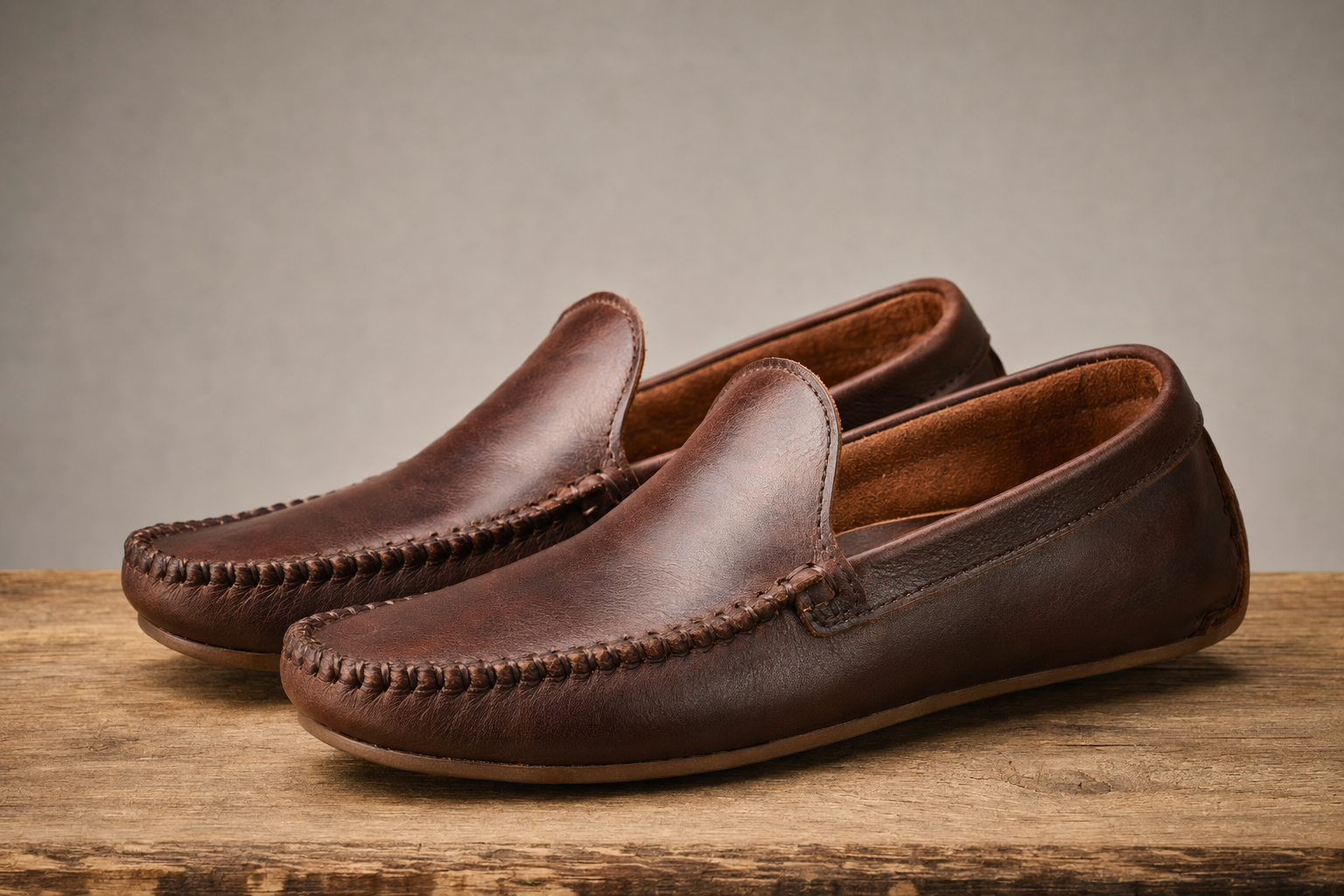
Moccasins are soft-soled shoes constructed from a single piece of leather wrapped around the foot and gathered at the top, with origins tracing back to Indigenous North American craftsmanship over 500 years ago. They are the oldest continuously produced footwear design on earth — and for brand buyers today, they represent a category with deep heritage appeal, broad unisex demand, and construction characteristics that directly shape sourcing decisions.
This guide is written for footwear brand owners, product managers, and sourcing professionals. It covers what defines a moccasin from a production standpoint, how the category has diversified across markets, which materials and construction methods drive cost and quality, and what to look for when evaluating a moccasin manufacturing partner.
The Shoe That Started It All
Indigenous Roots, Global Reach
Long before lasted construction, cementing, or injection molding, there was the moccasin. Indigenous peoples across North America — from the Algonquian nations of the Northeast woodlands to the Plains tribes and the Navajo of the Southwest — developed region-specific moccasin designs tailored to climate, terrain, and available materials. Soft-soled versions suited forest floors where the wearer needed to feel the ground; hard-soled rawhide variants protected against rocky desert terrain.
The word “moccasin” itself comes from the Algonquian language family — Powhatan makasin, Ojibwe makizin — and entered English through early colonial contact. But the construction principle was universal: a single piece of hide shaped to the foot, with minimal cutting and zero waste.
Why a 500-Year-Old Design Still Sells
No other footwear category carries this combination of authenticity and comfort. The moccasin’s defining feature — the wrap-around, foot-conforming construction — delivers a fit experience that modern lasted shoes cannot replicate. For brands, this translates into a compelling product story: heritage, craftsmanship, and a genuinely different wearing sensation. In a market saturated with vulcanized sneakers and cemented derbies, moccasins offer something rare — a product with a pre-industrial origin story that feels completely contemporary.
From Artifact to Accessory
The moccasin’s journey from Indigenous craft to commercial product accelerated in the 20th century. Brands like Minnetonka (founded 1946) brought the silhouette to mainstream America. European designers later reinterpreted it — Italian driving mocs from Tod’s and Car Shoe turned the soft sole into a luxury status symbol in the 1980s and 1990s. Today, moccasins sit at the intersection of craft heritage, casual luxury, and the global boom in comfort-first footwear. For a brand buyer, the takeaway is clear: this is not a trend. It’s a permanent category.
What Defines a Moccasin — Anatomy & Construction
The Non-Negotiable: Single-Piece Wrap-Around
A genuine moccasin is defined by its construction method, not its decoration. The upper is formed from a single piece of leather that wraps under the foot and is gathered — typically with a hand-stitched or machine-stitched apron — across the vamp. There is no separate insole board, no lasting process, and no rigid heel counter in the traditional form. The foot sits directly on the leather that forms the shoe’s bottom, creating the characteristic ground-feel that defines the category.
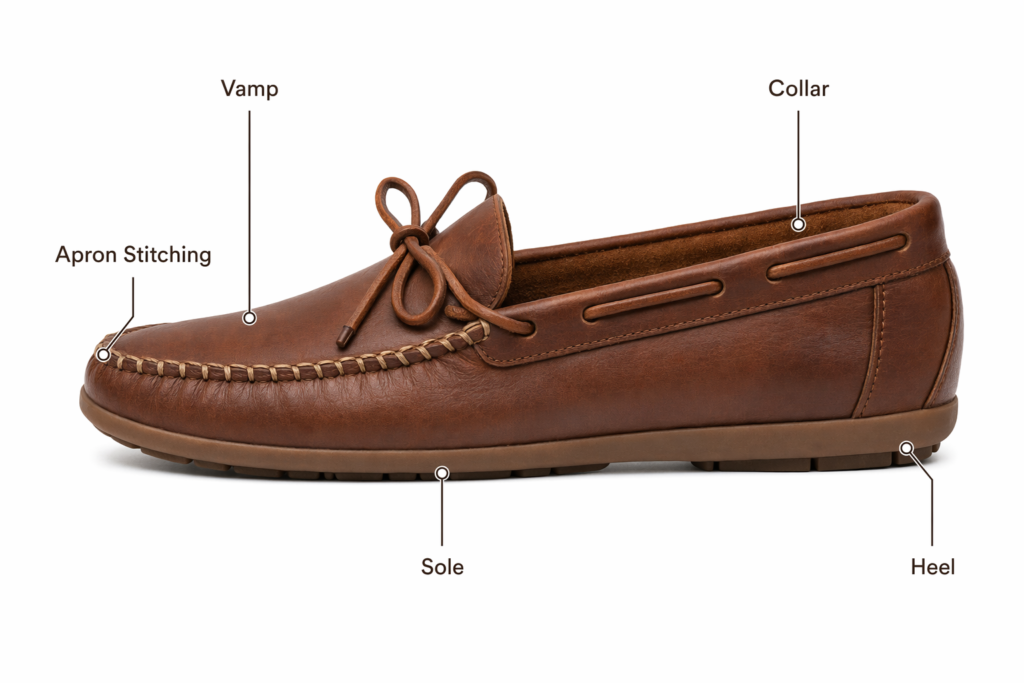
This is the key distinction between a true moccasin and a moccasin-toe shoe. Many factory-made shoes feature a moccasin-style stitched apron on the vamp — but are built on a conventional last with a cemented or Blake-stitched sole. These are moccasin-toe shoes, not moccasins. The difference matters for sourcing: true moccasin construction requires different tooling, different skill sets, and different quality control than standard lasted footwear.
Soft Sole vs. Hard Sole
| Type | Construction | Typical Use | Sourcing Complexity |
|---|---|---|---|
| Soft Sole | Single leather layer underfoot, no rigid structure | Indoor, light outdoor, driving | Lower — fewer components, fewer assembly steps |
| Hard Sole | Leather or rubber outsole attached to wrapped upper | Outdoor, street wear, camp mocs | Higher — requires sole attachment without a traditional lasting margin |
Moccasin vs. Loafer vs. Driving Shoe
These three categories overlap visually but diverge in construction — and confusing them leads to mis-spec’d orders:
| Feature | Moccasin | Loafer | Driving Shoe |
|---|---|---|---|
| Upper Construction | Single-piece wrap-around | Lasted, multi-piece upper | Single-piece wrap-around |
| Sole | Soft or hard, same leather or attached | Leather, rubber, or composite | Rubber pebble sole extending up the heel |
| Heel Counter | None (traditional) or minimal | Yes, structured | None — collapsible heel |
| Formality | Very casual | Smart-casual to formal | Casual |
| Key Market Signal | Heritage, craft, comfort | Versatility, polish | Luxury leisure |
The Modern Moccasin Landscape — Types & Markets
Camp Moccasin
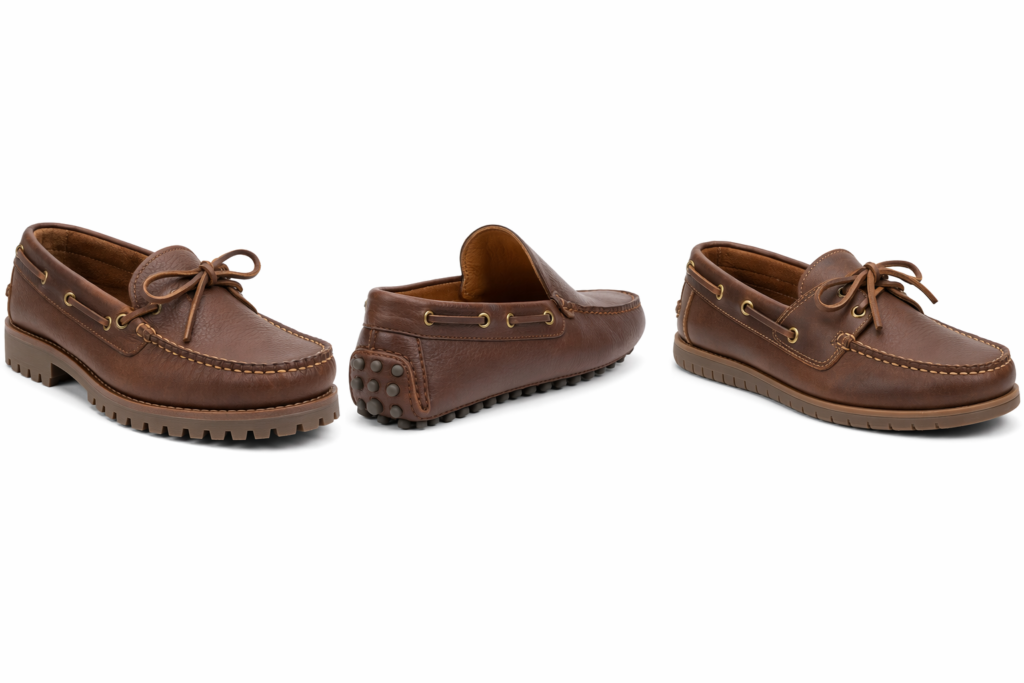
The camp moc is the rugged cousin. It pairs a moccasin-wrapped upper with a substantial rubber outsole — often a lug or ripple pattern — that makes it wearable on pavement, gravel, and light trails. The silhouette is chunkier than a traditional moc, with a visible sole unit that provides structure and durability. Camp mocs perform well in the North American outdoor-lifestyle segment and have gained traction in Japanese Americana and workwear-adjacent markets. From a sourcing standpoint, camp mocs require careful sole-to-upper bonding — the wrapped upper has no lasting margin, so the adhesive bond and stitch reinforcement must be precise.
Driving Moccasin
The driving moc is the most commercially significant variant in Europe. It features a soft, flexible upper with a rubber pebble sole that wraps up the back of the heel — designed to grip pedals and protect the leather when the foot rests on the car floor. Italian brands defined this category, and it remains strongly associated with Mediterranean luxury. For brand buyers, the driving moc’s key sourcing consideration is the sole mold: the pebble pattern is brand-specific, and custom molds add tooling cost and lead time.
Boat Shoe Hybrid
The boat shoe — technically a moccasin variant — adds a siped rubber sole for wet-surface grip and a 360-degree lacing system through the collar. It is the most functional of the moccasin family and the most commercially proven in the United States, where Sperry established the category in 1935. Boat shoes demand water-resistant leathers, rust-proof eyelets, and sole adhesion that survives repeated wet-dry cycling — all of which add quality-control touchpoints.
Regional Demand at a Glance
| Region | Dominant Type | Price Positioning | Key Buyer Concern |
|---|---|---|---|
| North America | Camp moc, boat shoe, classic soft-sole | Mid-market to premium | Heritage authenticity, material provenance |
| Europe | Driving moc, city moc | Premium to luxury | Leather quality, sole refinement, brand story |
| Japan | Camp moc, traditional-inspired | Mid-premium | Construction detail, stitch precision, material honesty |
Materials That Matter — Leather, Stitching & Sole
Upper Leather: Full-Grain vs. Suede
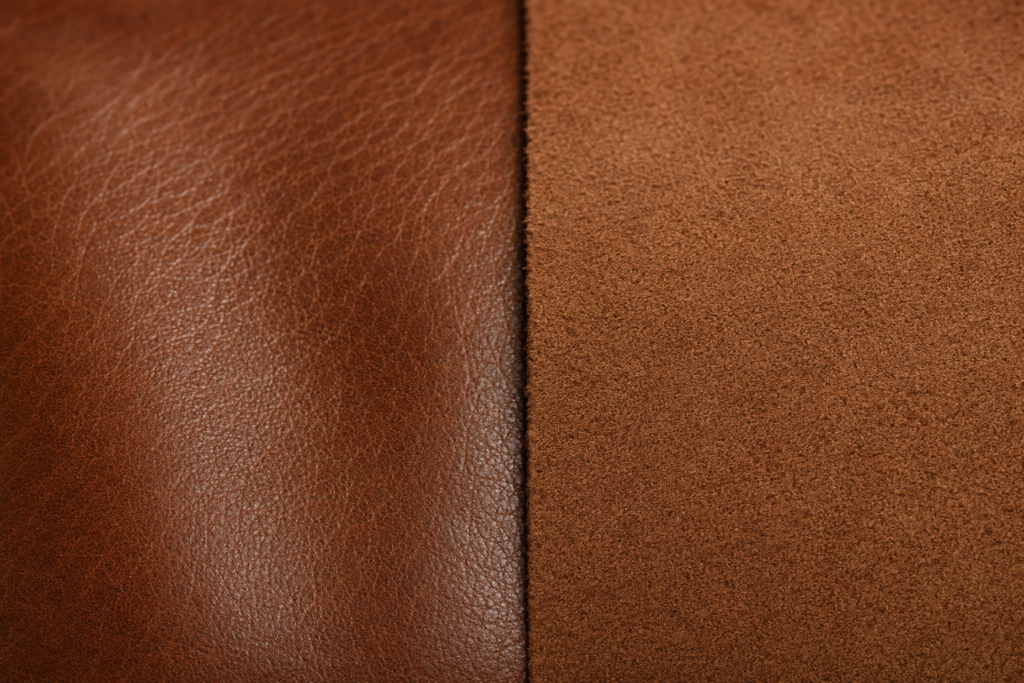
The moccasin’s single-piece construction puts the entire shoe’s visual identity into one material choice. Full-grain leather delivers structure, durability, and a clean surface for branding. Suede and nubuck offer a softer hand feel and a more casual visual — but require consistent nap direction across the entire upper, which is harder to achieve in single-piece cutting than in multi-piece lasted uppers.
Key sourcing considerations for upper leather:
- Thickness: 1.6–2.0mm for structured mocs; 1.2–1.6mm for soft-sole and driving variants
- Temper: Medium to soft — too stiff and the wrap-around won’t conform to the foot
- Grain consistency: Single-piece construction means there’s nowhere to hide flaws. A scar or brand on the hide becomes a scar on the shoe.
Stitching: Hand vs. Machine
The apron stitching — the visible seam where the gathered leather meets across the vamp — is the moccasin’s signature detail. Hand-stitching uses a needle and waxed thread, producing a slightly irregular, organic look that signals craft authenticity. Machine stitching is faster, cheaper, and more uniform — but loses the artisanal signal. For brands positioning in the mid-to-premium segment, hand-stitched aprons are a strong differentiator. The cost difference per pair is measurable: hand-stitching adds labor time and requires skilled workers, but the perceived value uplift typically exceeds the cost delta.
Sole Materials Compared
| Sole Type | Best For | Durability | Cost | Notes |
|---|---|---|---|---|
| Leather | Indoor, light outdoor, traditional | Moderate | $$ | Can be replaced; requires resoling over time |
| Rubber (sheet) | Camp moc, boat shoe | High | $ | Standard option; consistent quality |
| TPR (thermoplastic rubber) | Budget to mid-market | Moderate–High | $ | Moldable, lightweight; less premium signal |
| Pebble rubber (driving) | Driving moc | Moderate | $$ | Custom mold required; brand-specific tooling cost |
Sourcing Moccasins — What Brand Buyers Need to Know
Why Moccasin Construction Costs More
Moccasin production is fundamentally different from standard lasted footwear. The key cost drivers:
- Labor intensity: Wrap-around construction, hand-stitched aprons, and sole attachment without lasting margins all demand more skilled labor hours per pair than cemented or basic Blake construction.
- Material waste: Single-piece cutting limits nesting efficiency. A multi-piece upper can arrange pattern pieces to minimize hide waste; a one-piece moccasin upper cannot.
- Quality consistency: The gathered apron seam is the critical control point. Stitch tension, alignment, and gather distribution must be consistent across every pair — and inconsistency here is the single most common defect in moccasin production.
MOQ Realities
For OEM moccasin production, expect minimum order quantities of 500–1,000 pairs per style. Soft-sole and driving variants can sometimes start lower — around 300–500 pairs — because the construction has fewer components. Custom sole molds (required for pebble driving soles or branded outsole logos) add tooling costs of $500–$2,000 depending on complexity, and are typically amortized across the first production run or charged separately.
Quality Inspection Checklist
- Apron stitch consistency: Check tension, alignment, and gather distribution on every pair in the sample lot. A pulled stitch here is visible from three meters away.
- Sole adhesion: For hard-sole variants, press a thumbnail into the sole-to-upper seam. Any gap is a reject.
- Leather grain direction: On suede mocs, the nap must run in the same direction across the entire upper. Cross-nap panels are a cutting error.
- Heel fit: Traditional soft-sole mocs have no heel counter, so the collar must grip the foot without slipping. Test on-foot for heel lift.
- Symmetry: Left and right must be mirror images. Off-center apron seams or uneven collar heights are reject criteria.
- Stitch density: Hand-stitched aprons should show 5–7 stitches per inch. Fewer is a cost-cut; more often means the leather is perforated too aggressively and will tear.
Your Moccasin Manufacturing Partner
11 Years of Craft Footwear Production
XuFan Footwear (Jing County XuFan Footwear Co., Ltd.) has been manufacturing shoes from our Anhui, China facility since 2014. We operate an 8,023-square-meter factory with 2–3 production lines and an annual capacity of 1,200,000 pairs. Moccasins — from classic soft-sole silhouettes to hard-sole camp mocs and driving variants — are one of our core categories, alongside loafers, sandals, German Trainers, and Birkenstock-style footwear.
OEM/ODM Built Around Your Brand
We manufacture your designs under your brand. Send us a reference sample, a tech pack, or a mood board — we return a wearable prototype within two weeks. Our moccasin-specific capabilities include:
- Hand-stitched and machine-stitched apron options to match your brand’s positioning
- Full-grain leather, suede, and nubuck uppers sourced to your specification
- Custom sole molds for driving pebble patterns and branded outsole logos
- Debossed, foil-stamped, or metal-plaque branding on sock-liner or heel
- Custom packaging: boxes, dust bags, hang tags to your design
- MOQ starting at 500–1,000 pairs per style, with flexible terms for first-time partners
Export-Ready, Certified, Responsive
We ship FOB, CIF, and DDP worldwide with established logistics to Europe and Japan. Every order is backed by BSCI and ISO certifications, and we provide compliance documentation — REACH, CPSIA, or your market’s requirements — on request. Inquiries receive pricing, a sampling timeline, and clear answers within 24 hours.
→ xufanshoes.com
📧 info@xufanshoes.com
Sources & Further Reading
Jing County XuFan Footwear Co., Ltd. | OEM/ODM Footwear Manufacturer Since 2014 | Anhui, China | BSCI · ISO Certified